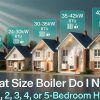
What Size Boiler Do I Need for a 1, 2, 3, 4, or 5 Bedroom House?
Boiler Service Brighton | Boiler Repair Brighton | Gas Engineer Brighton | Central Heating Services Brighton
Choosing a new boiler is a significant investment for any homeowner. Walk into any showroom or browse online, and you’re immediately confronted with a wall of numbers: 24kW, 30kW, 35kW, 42kW. It’s easy to feel overwhelmed.
The common assumption is that boiler size corresponds to the physical dimensions of the unit, but that’s a myth. In the heating industry, boiler “size” refers to its power output, measured in kilowatts (kW). Getting this number right is the difference between a warm, efficient home with low energy bills and a property that is either cold and underpowered or wasting money on a boiler that is too powerful for its needs.
This guide provides a definitive, data-backed answer to the question, “What size boiler do I need?” We will break down the numbers, explain the key factors, and provide a professional index to help you, whether you live in a 1-bedroom flat in Brighton or a 5-bedroom manor house.
Blog Index
- Introduction: Understanding Boiler “Size”
- The Goldilocks Principle: Why Correct Sizing Matters
- The Core Rule: Bedrooms vs. Bathrooms vs. Radiators
- Data-Driven Sizing Tables
- Combi Boilers (Most Common)
- System & Regular (Conventional) Boilers
- The Deep Dive: Factors Affecting Your Boiler Size
- Bathroom Count & Hot Water Demand
- Radiator Count & Heat Loss
- Insulation & Property Age
- Cost & Price Analysis: Budgeting for Your New Boiler
- Boiler Price Brackets by kW
- Installation Costs
- Services Base: Finding Expert Help
- Boiler Service Brighton
- Boiler Repair Brighton
- Gas Engineer Brighton
- Central Heating Services Brighton
- UK Government & Regulatory Standards
- Conclusion: Making the Right Choice
- Introduction: Understanding Boiler “Size”
When we ask “what size boiler do I need?” we are not asking about the physical footprint of the appliance. Modern boilers are compact and designed to fit in kitchen cupboards or lofts.
Instead, we are asking about the power output. A boiler’s kW rating indicates how much energy it can transfer to your central heating and hot water system.
The primary distinction lies in the type of boiler:
- Combi (Combination) Boilers: These provide heating and hot water on demand. Their “size” is largely dictated by how quickly they can heat water for taps and showers.
- System & Regular Boilers: These work with a hot water cylinder. Their “size” is determined by how quickly they can heat the water in the tank and maintain radiator temperatures.
-
The Goldilocks Principle: Why Correct Sizing Matters
Oversizing or undersizing a boiler is a common mistake that can cost you hundreds of pounds in energy bills and repair costs.
- Boiler Too Small (Underpowered): If your boiler is too small, it will struggle to heat your home on the coldest winter days. You may find that your radiators are lukewarm, or that the hot water runs cold the moment someone turns on another tap. The boiler will run constantly, trying to meet demand, leading to higher energy consumption and a shorter lifespan.
- Boiler Too Big (Oversized): This is surprisingly common. An oversized boiler will “cycle” on and off. Think of it like a car stuck in stop-start traffic rather than cruising on a motorway. It uses more fuel and puts the components under greater stress, accelerating wear and tear. Data shows that the average UK home has a maximum heat requirement of just 6-8kW on a very cold day, yet many homes have 30kW+ boilers that are never used efficiently.
-
The Core Rule: Bedrooms vs. Bathrooms vs. Radiators
The legacy method of sizing a boiler purely by the number of bedrooms is outdated. The modern approach dictates that hot water demand (number of bathrooms) is the primary driver for combi boiler sizing.
Boiler size is determined primarily by hot water demand (number of bathrooms) rather than just bedrooms. Properly sizing ensures efficiency and adequate heating for radiators.
The standard industry guidelines are:
- 1–2 Bedroom House/Flat (1 Bathroom, <10 Radiators): 24-27 kW (Combi) / 9-18 kW (System/Regular)
- 3 Bedroom House (1-2 Bathrooms, 10-15 Radiators): 28-34 kW (Combi) / 18-26 kW (System/Regular)
- 4 Bedroom House (2 Bathrooms, 15-20 Radiators): 30-35 kW (Combi) / 18-26 kW (System/Regular)
- 5+ Bedroom House (2+ Bathrooms, 20+ Radiators): 35-43 kW (Combi) / 27-40 kW (System/Regular)
-
Data-Driven Sizing Tables
To help you visualize, here are comprehensive tables based on aggregated industry data.
Table 1: Combi Boiler Sizing (By Property Type & Hot Water)
|
Property Size |
Bedrooms | Bathrooms | Radiators | Recommended Combi Boiler Size | Hot Water Flow Rate (LPM) |
|
Small Flat/House |
1-2 | 1 | Up to 10 |
24 – 27 kW |
9 – 12 LPM |
|
Medium House |
3 | 1 | 10-15 | 28 – 30 kW |
12 – 14 LPM |
| Medium House | 3 | 2 (En-suite) | 10-15 | 30 – 34 kW |
14 – 16 LPM |
|
Large House |
4 | 2 | 15-20 | 30 – 35 kW | 14 – 16 LPM |
|
Large House |
4 | 3 | 15-20 | 35 – 40 kW |
16+ LPM |
| Executive Home | 5+ | 3+ | 20+ | 35 – 43 kW |
16+ LPM |
Table 2: System & Regular Boiler Sizing (By Property Age & Insulation)
Note: These boilers store hot water, so the heating output can be lower.
|
Property Age / Insulation |
1 Bed | 2 Bed | 3 Bed | 4 Bed |
5+ Bed |
|
Pre-1900 (Poor Insulation) |
7-9 kW | 8-10 kW | 9-12 kW | 10-14 kW | 14-16 kW |
|
1920s-1930s (Some Insulation) |
6-8 kW | 7-9 kW | 8-11 kW | 9-12 kW | 12-15 kW |
| 1950-1980s (Moderate Insulation) | 5-7 kW | 6-8 kW | 7-10 kW | 8-11 kW |
10-14 kW |
| 1990+ (Well Insulated) | 4-6 kW | 5-7 kW | 6-9 kW | 7-10 kW |
9-12 kW |
-
The Deep Dive: Factors Affecting Your Boiler Size
Bathroom Count & Hot Water Demand
This is the most critical factor for combi boilers. A combi boiler heats water directly from the mains. If you have two bathrooms and two people want a shower at the same time, the boiler must have a high enough flow rate (litres per minute) to serve both.
- 1 Bathroom: A flow rate of 9-12 LPM is usually sufficient.
- 2 Bathrooms: You need a flow rate of 14 LPM or higher.
- 3+ Bathrooms: A combi boiler may not be suitable. For homes with 3 or more bathrooms, a System boiler with a large hot water cylinder is often the better option to ensure consistent pressure.
Radiator Count & Heat Loss
A simple rule of thumb is to allow 1.5 to 2 kW for each radiator, plus 2-3 kW for hot water. This is for the “heating side” of the boiler.
- 10 Radiators: 15-20 kW requirement for heating.
- 15 Radiators: 22-30 kW requirement.
However, a well-insulated home loses heat slower. If your loft is insulated and you have double-glazing, you can often size down. A well-insulated home can often use a 24kW combi boiler effectively for a 3-bedroom house, whereas a draughty Victorian home might need the 30kW version just to keep the radiators hot.
Property Age & Insulation
The age of your property is a massive factor for system and heat-only boilers.
- New Build (2000 onwards): Very high insulation standards. A 4-bedroom new build may only require 7-8 kW of heating power.
- Victorian/Edwardian (Pre-1920): Solid walls, high ceilings, poor insulation. A 4-bedroom house may require 10-12 kW of heating power.
-
Cost & Price Analysis: Budgeting for Your New Boiler
The price of a boiler is directly linked to its size (kW). Below is a price analysis based on aggregated market data.
Boiler Price Brackets (Unit Cost Only)
|
Boiler Size (kW) |
Typical Boiler Type |
Price Range (Unit Only) |
|
18-24 kW |
Small Combi / System |
£500 – £900 |
|
24-27 kW |
Standard Combi |
£650 – £1,100 |
|
28-35 kW |
Large Combi / System | £850 – £1,400 |
| 35-42 kW | High Output Combi / System |
£1,100 – £1,800 |
Installation Costs (Labour & Materials)
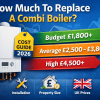
Installing a boiler typically costs between £500 and £1,500 depending on the complexity.
- Like-for-Like Swap (Combi to Combi): £500 – £800
- System Conversion (Regular to Combi): £1,200 – £2,500 (This involves removing tanks in the loft, pipework modifications, and potentially a powerflush).
Total Cost Estimates
- 1-2 Bedroom Flat (24kW Combi): £1,500 – £2,200 (Fully installed)
- 3 Bedroom House (30kW Combi): £1,800 – £2,500
- 4-5 Bedroom House (35kW System + Cylinder): £2,500 – £4,000
-
Services Base: Finding Expert Help
To ensure your new boiler is correctly sized and installed, you must use a qualified professional. This is where local expertise becomes invaluable.
If you are located in the South East, ensuring your system is sized correctly by a local expert is crucial.
- Boiler Service Brighton: Regular servicing (annually) is mandatory to maintain your warranty and ensure the boiler is running at its designed efficiency. A service ensures that the “range rating” (output adjustment) set during installation hasn’t drifted, keeping your bills low.
- Boiler Repair Brighton: If your existing boiler is cycling on and off (short-cycling) or struggling to heat the home, a Gas Engineer Brighton can diagnose if the boiler was originally undersized or if a component has failed.
- Gas Engineer Brighton: A certified Gas Safe Register engineer is the only person legally allowed to work on gas appliances in the UK. When sizing a new boiler, they are responsible for performing a heat loss calculation to confirm the theoretical size matches your home’s specific needs.
- Central Heating Services Brighton: Many homes in Brighton are older properties with unique challenges (e.g., solid walls, limited space for flues). Engaging a local Central Heating Services team ensures the installer understands the local housing stock and can recommend the correct size, be it a compact 24kW combi for a flat or a high-output system boiler for a townhouse.
-
UK Government & Regulatory Standards
When purchasing a new boiler, it is vital to ensure it complies with current UK regulations. The UK Government mandates that all new gas boilers installed in England and Wales must be condensing boilers with an efficiency rating of at least 92% (ERP A-rated). Additionally, any new boiler installation must be carried out by a Gas Safe Registered engineer.
For official guidance on energy efficiency standards and homeowner rights regarding heating installations, please refer to the UK Government’s official planning portal and energy efficiency regulations:
-
Conclusion: Making the Right Choice
Choosing the right size boiler is a balancing act between heating demand, hot water usage, and property efficiency.
- For a 1-2 bedroom flat: A 24-27kW combi boiler is almost always the best choice.
- For a 3 bedroom house: Look at 28-34kW combi boilers. If you have 2 bathrooms, prioritize a boiler with a high flow rate (14+ LPM).
- For a 4-5 bedroom house: Consider a 30-42kW combi if you have 2 bathrooms and good mains water pressure. If you have 3+ bathrooms or poor water pressure, invest in a System boiler with a large unvented cylinder.
Ultimately, the data points to the same conclusion: Don’t oversize. Ask your installer to perform a heat loss calculation and “range rate” (reduce the output) of your new boiler to match your home’s specific heat requirement, which is often only 6-10kW.
Still unsure? Ask yourself this key question:
How many bathrooms are in your home, and do you frequently use more than one shower at the same time?
Your answer will directly determine whether you need a higher-flow combi boiler (for simultaneous showers) or whether a system boiler with a cylinder would serve you better.
By following the data and tables in this guide, you can confidently approach your Gas Engineer Brighton and ensure you get the perfect boiler for your home, ensuring warmth, comfort, and energy efficiency for years to come.