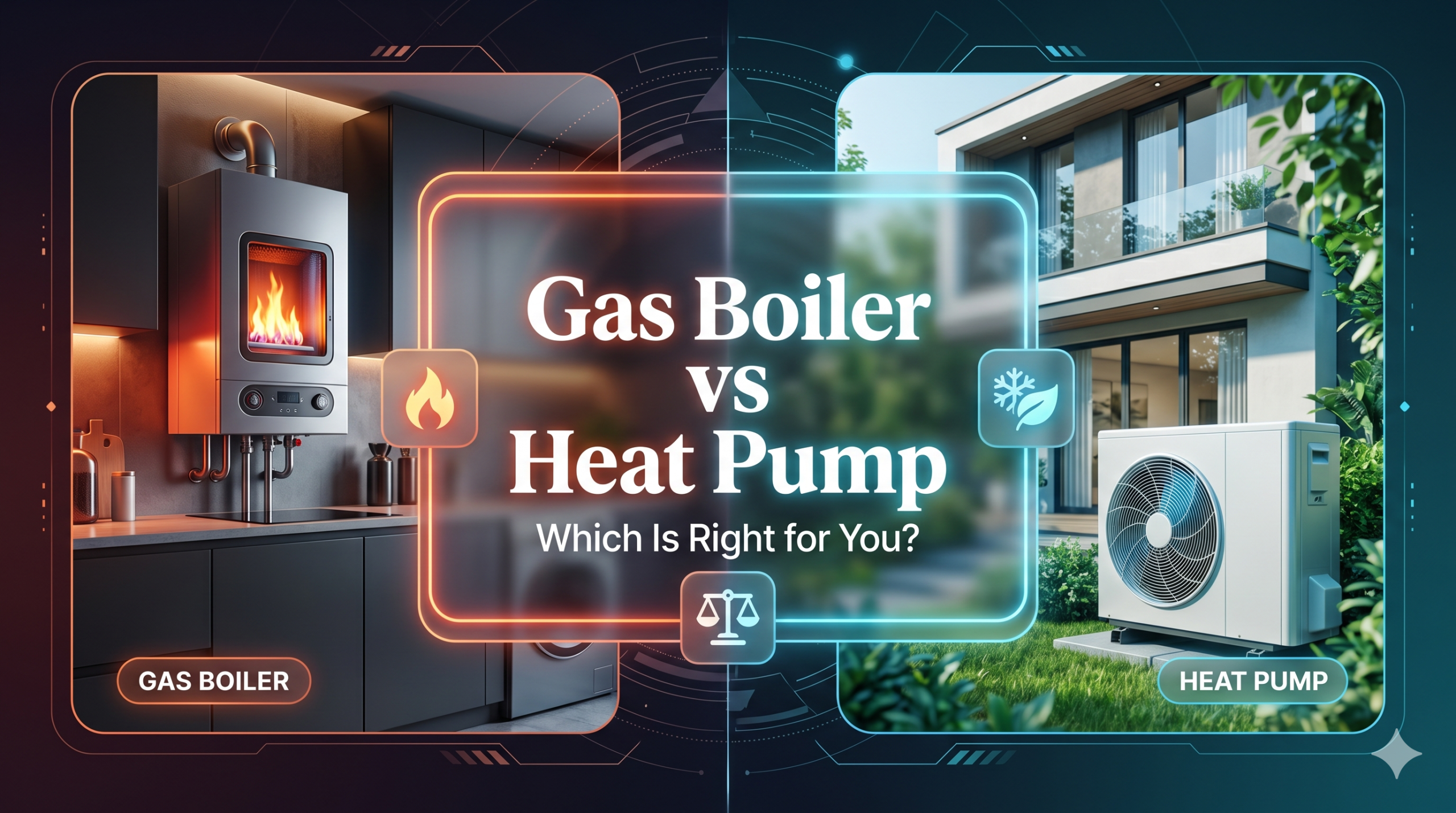

Gas Boiler vs Heat Pump: Which Is Right for You?
A complete, data-driven guide to costs, grants, efficiency, and which heating system genuinely suits your UK home — from a qualified Gas Engineer in Brighton.
Boiler Service Brighton | Boiler Repair Brighton | Gas Engineer Brighton | Central Heating Services Brighton
📋 Index — Contents
1. Quick Answer: Which Is Right for You?
2. How Each System Works
3. Full Side-by-Side Comparison
4. Installation & Running Costs (2025 Data)
5. UK Government Grants & Financial Support
6. Decision Guide: Which Suits Your Home?
7. When to Book a Boiler Service or Repair in Brighton
8. Frequently Asked Questions
1. Quick Answer: Which Is Right for You?
A Gas Boiler is best if you need a lower upfront cost, have a poorly insulated older property, or need a straightforward like-for-like replacement. A Heat Pump is right for you if your home is well-insulated, you want to reduce your carbon footprint, and you’re looking for lower long-term running costs with access to a £7,500 government grant.
The heating debate between gas boilers and air source heat pumps is one of the most important decisions UK homeowners will face over the next decade. With the UK government’s commitment to net zero by 2050 and the ongoing Boiler Upgrade Scheme, more households than ever are weighing their options.
This guide cuts through the noise with real UK cost data, government grant information, and practical advice — whether you’re considering a Boiler Repair in Brighton, a full central heating replacement, or a switch to renewable technology.
How Each System Works
Gas Boilers: Traditional Rapid Heat
A gas boiler burns natural gas to heat water, which then circulates through your radiators and hot water taps. Modern condensing boilers recover heat from exhaust gases, achieving efficiency ratings of 85% to 92%. They operate at high flow temperatures — typically 70°C to 80°C — which is why they heat homes so quickly and effectively, even in poorly insulated properties.
For decades, the gas boiler has been the backbone of UK central heating. A qualified Gas Engineer in Brighton can install a replacement boiler in a single day, and the system integrates seamlessly with existing pipework and radiators.
Air Source Heat Pumps: Efficient Renewable Heat
An air source heat pump (ASHP) does not burn fuel. Instead, it extracts ambient warmth from the outside air — even at temperatures as low as −15°C — and uses electricity to compress and amplify that heat to usable temperatures. Because it moves heat rather than generating it from combustion, a heat pump is extraordinarily efficient.
For every 1 kWh of electricity consumed, a modern ASHP produces 3 to 4 kWh of heat — a Coefficient of Performance (CoP) of 300–400%. This is physically impossible for any combustion system.
Heat pumps operate at lower flow temperatures of 35°C to 55°C, which means they work best as a slow, steady background heat source. This is ideal for well-insulated homes with underfloor heating or larger radiators, but requires careful consideration in older properties.
Key technical point: Heat pumps are most efficient when run continuously at lower temperatures. Unlike a gas boiler you switch on for a few hours, a heat pump works best running steadily throughout the day — which is why home insulation is so critical to making them cost-effective.
Full Side-by-Side Comparison
The table below uses data verified from Ofgem, the Energy Saving Trust, and leading UK installers to give you an accurate 2025 picture.
Factor |
🔥 Gas Boiler |
🌿 Air Source Heat Pump |
|---|---|---|
| Fuel Source | Natural gas (fossil fuel) | Electricity (renewable-compatible) |
| Flow Temperature | 70°C – 80°C | 35°C – 55°C |
| Efficiency Rating | 85% – 92% Good | 300% – 400% (CoP) Excellent |
| Installation Cost | £2,000 – £4,000 Lower upfront | £10,000 – £15,000 (before grants)Higher upfront |
| After £7,500 Grant | N/A | From ~£6,856 (eligible homes) Competitive |
| Typical Lifespan | 10 – 15 years Average | 20+ years Longer |
| Carbon Emissions | High (combustion) High carbon | Low / zero at property Low carbon |
| Installation Time | 1 day | Approx. 1 week |
| Radiator Changes Needed? | No — works with existing | Often yes — larger radiators may be needed |
| Best for | Older, less-insulated properties | Modern, well-insulated homes |
| Potential Annual Savings | Up to £415/yr vs older systems | Up to £385/yr vs older systems |
| Gov. Grant Available? | No | Yes — £7,500 (England & Wales) BUS Scheme |
| Annual Servicing Cost | £80 – £120 | £150 – £300 |
All figures are based on 2025 UK market data verified against government and industry sources. Prices vary by property type, region, and specification — always obtain quotes from accredited engineers before making a decision.
Installation & Running Costs: 2025 UK Data
Cost is the single most important factor for most households. Here is an honest, data-backed breakdown — without the marketing spin.
Installation Costs at a Glance
Installation Cost Comparison (Visual)
Running Costs: The Long-Term Picture
Running costs are where the heat pump’s efficiency advantage becomes significant — but it depends heavily on two factors: your home’s insulation and electricity tariff.
Electricity currently costs approximately four times more per unit (kWh) than gas in the UK. However, because a heat pump produces 3–4 kWh of heat per 1 kWh of electricity used, the effective cost gap narrows considerably. In a well-insulated home on a specialist heat pump electricity tariff, running costs can match or undercut gas.
Over a 15-year period — the typical lifespan of a gas boiler — a well-installed heat pump in a suitable property can save thousands of pounds and eliminates one boiler replacement cycle entirely, as heat pumps last 20+ years.
Long-term cost verdict: A heat pump is cheaper than a gas boiler over 10–15 years in the right home. If your property is poorly insulated or you primarily use heating in short bursts at high temperature, a gas boiler remains the more cost-effective choice in the short to medium term.
Pros & Cons Summary
Gas Boiler — Advantages
- Lower upfront installation cost (£2,000–£4,000)
- Rapid high-temperature heat — ideal for cold snaps
- Installs in a single day with minimal disruption
- No radiator or pipework upgrades needed
- Familiar technology — easy to find a Gas Engineer in Brighton
- Works well in poorly insulated older properties
Gas Boiler — Disadvantages
- Burns fossil fuels — high carbon emissions
- Running costs tied to volatile global gas prices
- Shorter lifespan of 10–15 years
- No government grant available for installation
- Will become less viable as UK decarbonises heating
Heat Pump — Advantages
- 300–400% efficiency — far exceeds any combustion system
- £7,500 government grant available (BUS Scheme)
- Lifespan of 20+ years — outlasts two gas boiler cycles
- Zero emissions at the property
- Lower long-term running costs in suitable homes
- Future-proof as the UK grid becomes greener
Heat Pump — Disadvantages
- Higher upfront cost (£10,000–£15,000 before grants)
- Requires good home insulation to work efficiently
- May need larger radiators or underfloor heating
- Installation takes approximately one week
- Provides steady, lower-level heat rather than rapid bursts
UK Government Grants & Financial Support
Financial support from the UK government significantly changes the economic calculation for heat pumps. Here is every major scheme available to UK homeowners in 2025.
Boiler Upgrade Scheme (BUS) — £7,500 Grant
The UK government’s flagship grant for heat pump adoption. Eligible households in England and Wales can receive £7,500 off the cost of an air source heat pump installation. The grant is paid directly to your MCS-certified installer and deducted from your invoice — you never see the money, it simply reduces what you pay.
Eligibility conditions include: property in England or Wales, existing heating system to replace, no previous BUS grant claimed, and installation by an MCS-accredited installer.
Scotland Heat Pump Grant — Up to £15,000 Support
Scottish homeowners have access to a separate, equally generous government scheme. It offers a £7,500 grant plus an optional interest-free loan of up to £7,500 — giving eligible Scottish households up to £15,000 in combined support for a heat pump installation.
Additional Support: ECO4 Scheme
Lower-income households or those with an Energy Performance Certificate (EPC) rating of D or below may also qualify for the ECO4 (Energy Company Obligation) scheme, which funds insulation upgrades and in some cases heating system improvements. Strong insulation is a prerequisite for an efficient heat pump — making ECO4 a valuable first step for older properties.
Decision Guide: Which Heating System Suits Your Home?
Rather than a generic recommendation, use the checklist below to determine which system genuinely fits your property and circumstances. If you are unsure, booking a home energy assessment with a certified professional is always the best starting point.
Choose a Gas Boiler if…
- ✓Your budget is limited and you need an immediate replacement
- ✓Your home has solid walls with no insulation (or retrofitting is prohibitively expensive)
- ✓You have single-glazed windows and significant draughts
- ✓You only use heating for short periods at high heat
- ✓You rent, or plan to sell within a few years
- ✓You already have a good gas connection and modern radiators
- ✓You need a boiler repaired or serviced urgently in Brighton
Choose a Heat Pump if…
- ✓Your home has good loft and wall insulation (EPC C or above)
- ✓You have or plan to install underfloor heating or larger radiators
- ✓You want to reduce your carbon footprint significantly
- ✓You are planning a major renovation or self-build
- ✓You want to future-proof against rising gas prices
- ✓You qualify for the £7,500 BUS grant
- ✓You have solar panels or plan to install them
What About Hybrid Systems?
A growing option in the UK is the hybrid heat pump — which combines an air source heat pump with a gas boiler backup. On mild days, the heat pump handles all your heating efficiently. On the coldest winter days, the gas boiler tops up the system. This gives you the efficiency benefits of a heat pump while retaining the rapid high-temperature capability of gas, and is often a practical compromise for homes that are not yet fully optimised for a heat pump alone.
Hybrid systems typically cost £7,000–£12,000 installed and may qualify for partial grant support. They are an increasingly popular choice for the millions of mid-terrace and semi-detached UK homes that fall between the clear-cut cases.
When to Book a Boiler Service or Repair in Brighton
Whether you opt for a gas boiler or a heat pump, regular maintenance is essential for safety, efficiency, and longevity. Here is when to call a professional for your central heating in Brighton.
Annual Boiler Service — Why It Matters
An annual Boiler Service in Brighton by a Gas Safe registered engineer is not just good practice — it is the best way to keep your warranty valid, maintain efficiency, and catch small faults before they become expensive failures. A service typically includes: checking for carbon monoxide leaks, cleaning the heat exchanger, inspecting the flue, testing safety controls, and verifying combustion efficiency.
Skipping annual servicing is one of the most common reasons boilers fail prematurely. A properly serviced boiler can exceed its rated 10–15 year lifespan significantly.
Signs You Need Boiler Repair in Brighton
Do not ignore these warning signs. Call a qualified Gas Engineer in Brighton promptly if you notice:
- Unusual banging, whistling, or clunking sounds (kettling, air in the system)
- Yellow or orange flame instead of the normal blue flame
- Increased gas bills without increased usage
- The boiler keeps switching itself off (lockout)
- Radiators not heating evenly or taking much longer than usual
- A pilot light that will not stay lit
- Any smell of gas — this is an emergency: call the National Gas Emergency line on 0800 111 999 immediately
Central Heating System Checks
If your Central Heating Services in Brighton is underperforming, the problem may not be the boiler itself. Common system-wide issues include: low boiler pressure, air-locked radiators (requiring bleeding), a failing pump, or a seized zone valve. A skilled heating engineer can diagnose and resolve all of these, often in a single visit, at far less cost than a premature boiler replacement.
Professional tip: Before replacing an ageing boiler, always have a Gas Safe registered engineer assess whether a repair is viable. A boiler under 10 years old with a single fault is almost always worth repairing rather than replacing. Older than 15 years? Replacement — potentially with a heat pump — becomes the better long-term investment.
Frequently Asked Questions
Over a 15-year period, a heat pump is typically cheaper to run than a gas boiler in a well-insulated home. While electricity costs more per unit than gas, a heat pump’s 300–400% efficiency means you consume far less energy overall. Savings depend heavily on your insulation level and electricity tariff. Specialist heat pump tariffs can reduce the electricity cost gap considerably.
The Boiler Upgrade Scheme (BUS) is a UK government grant of £7,500 towards the cost of installing an air source heat pump. It applies to properties in England and Wales. You must use an MCS-accredited installer, and the grant is paid directly to them — reducing your invoice. Most owner-occupied homes with an existing heating system to replace will qualify. Check your eligibility via the government’s official grant checker.
Technically yes, but it will not be efficient unless the insulation is improved. Heat pumps work at lower flow temperatures and require the home to retain heat well. For solid-wall Victorian or Edwardian terraces, you may need external or internal wall insulation, loft insulation, double glazing upgrades, and potentially larger radiators — all before the heat pump will perform cost-effectively.
Air source heat pumps typically last 20+ years with proper servicing. Gas boilers have an average lifespan of 10–15 years. Over a 20-year period you would typically replace a gas boiler at least once, whereas a heat pump installed today could still be running in 2045.
Every year, without exception. An annual boiler service by a Gas Safe registered engineer keeps your warranty valid, ensures your boiler is running safely and efficiently, and identifies minor faults before they become costly breakdowns. In Brighton, this service typically costs between £80 and £120 depending on the engineer and any parts required.
New-build homes in the UK built to modern standards are well-insulated and are ideal candidates for heat pumps. New-build regulations increasingly require low-carbon heating, and developers are already specifying heat pumps as standard in many cases. For a new-build, an air source heat pump with underfloor heating is typically the most efficient, comfortable, and future-proof solution.
A thorough boiler service includes: visual inspection of the boiler and flue, checking for gas leaks, cleaning the heat exchanger and burner, testing combustion efficiency, checking all safety devices and controls, inspecting the expansion vessel, verifying the system pressure, and issuing a service record. Only a Gas Safe registered engineer is legally permitted to work on gas appliances in the UK.
Need Expert Central Heating Advice in Brighton?
Whether you need a boiler service, boiler repair, a gas safety check, or want to explore your heat pump options — our Gas Safe registered engineers in Brighton are ready to help.
📞 Call for Boiler Repair Brighton
Get a Free Heat Pump Assessment